In the process of fielding essays for the 2026 issue of New Chaucer Studies: Pedagogy and Profession‘s cluster on Collaboration, we learned about this pair of cross-disciplinary, collaborative essays. We learned from Sandy Feinstein (PSU medievalist) and Bryan Wang (PSU biologist) that their multi-vocal fiction originated with a course they developed in an effort to bring, if not harmony, then alternating and overlapping vocalizations that meet in metaphor, reconciliation, and shared wonder. The initial voice—Sandy’s—seeks to make medieval literature come alive, literally, in the hope of “resurrecting” interest in early texts and the illuminating art that contributed to the development of natural history, scientia (knowledge) or science. In the final section, a synthetic biologist relates the development of methods to engineer creatures that previously lived only in memory and imagination, with a faint strain of ethical concerns still audible amid the clamor for scientific and technical progress. The polyphony voices the richness of a community constituted of disparate “parts” that work together to solve complex scientific, ethical, and artistic problems. Nic, initially, a chemistry major, had taken two medievalism courses with Sandy, then two courses she and Bryan designed, “Creativity” and “From Beast Books to Resurrecting Dinosaurs.” You could say that it is the artist, Nic, who is the link between humanist-dreamer and rationalist-scientist, at least as represented in the story. The result are two works co-authored with students, which highlight how we see and hear and present our different worlds to make one, however seemingly unlikely, old-new world.
Five Years of Magical Learning: Disappearing Act, Silencing the Sorcerer, Empowering the Student
By. Sandy Feinstein, Bryan Shawn Wang, and Safitaj Sindhar
Now You See Me, Now You Don’t

I teach old stuff: the Middle Ages, before and after, up to a point. Not what students expect to find in a class in which DNA and genetic engineering are also taught, but they were and continue to be in From Beast Books to Resurrecting Dinosaurs. My colleague, Bryan Wang, teaches molecular biology, and, not surprisingly, we see things differently, even each other. I know, for one, that he has described me, his co-teacher, as “slight in stature,” which sounds almost delicate, and is not at all how I see myself. For, in my mind, I am huge, like a dragon. But Bryan has actually examined molecules, classified protein structures and distinguished mutations—he was not trained to see dragons. My students see the fire, and if I say I can fly, they don’t usually contradict me—after all, I am old, older than the discovery of DNA, and more familiar with fables, bestiaries, and Cavendish’s Blazing World than with modern, molecular orders of classification. So, wary of the unpredictable and what is unfamiliar, students keep their eyes on the dragon, not quite sure what she may do. Like all animals in the biosphere, dragons are identified with specific habitats and behaviors. For this dragon, jewels are hidden in the woods, where students are led to collect creatures like millipedes and flies, or at the creek, where the rock doves perch and mallards dabble, or at the stone bridge guarded by knights disguised as fishermen. Machines are ignored, a modern mystery better left to those whose lives depend on them.
Once upon a time, which now seems long ago, as the semester began to warm and spring approached with later light and migratory birds, it was time to yield to a master of machines and molecules. The dragon and her stories had reached an end, suspended in time and place by a seemingly mild magician: poof, and a new view emerged, the past put in its place. His understanding of the unseen world would take on added urgency when none of us could meet in person, when the cause of this radical change was a virus that while taking on mythic proportions could not actually be seen, except by the magic of high powered machinery. To manage the myths, he imposed order with scientific models that would illuminate creatures of all kinds, including viruses. He’d lead the students, and me, to see connections between the hierarchies of the past that included dragons explored in our classroom to phylogenies of the present that would encompass the coronavirus on Zoom.
As if by magic, my flights ceased. All flights did. We all took residence in our separate lairs, from where we watched, and I became invisible. The magic of an old university computer without a camera erased all but my occasional roar. So, I listened. I observed. Boxes appeared, filled with students who looked curiously comfortable, attentive, open to this unanticipated change of venue and plan.
Together they grasped contemporary theories challenging and discrediting the hierarchies of ancient, medieval, and early modern natural histories. Cells, genes, mutations, the literal DNA of invisible creatures replaced the Book of Beasts. I tried to adapt and to understand how they so easily adjusted to a radically new environment, to words travelling by satellite, where everyone became literally two dimensional, diminished in physical size, but no less present.
The teachers still had work to do, and, as usual, the students did assignments, as most students tend to do. But as the days passed, the depth of the students’ achievement became clear when they could make even a dragon disappear.

Mastering the Mute Button
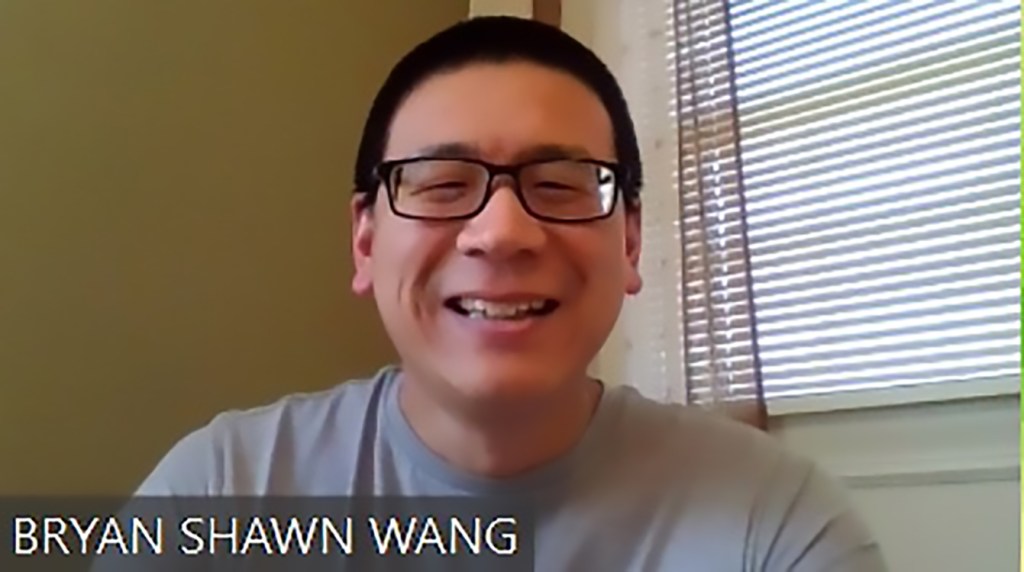
The science fiction writer Arthur C. Clarke said, “Any sufficiently advanced technology is indistinguishable from magic.” I’m a scientist, but I can understand the sentiment. As part of the curriculum in our course, From Beast Books to Resurrecting Dinosaurs, we cover a series of recent breakthroughs in synthetic biology. Bringing woolly mammoths back, mixing up living microbes from scratch, recasting DNA—the language of life—with extra letters: these efforts stem from genetic engineering technologies I routinely employed as a student in the 1990s, and yet reading about and discussing these advances with undergraduates now leaves me nearly spellbound.
In other words, even things that are comprehensible can inspire awe in me; how much more did those beyond my grasp, especially that pandemic year. Take, for example, a now common, indispensable item in the online instructor’s bag of tricks. In one instant, hundreds of miles separated our students; in the next, they were collected in a tidy array right before our eyes. Zoom teleported them, and I gaped at this power to summon—and I trembled at the techno-wizardry underlying the frictionless platform, particularly when my Wi-Fi connection failed, or my fumbling with the annotation and chat features threatened to expose the ignorant, impotent self behind my screen.
Perhaps due to my scientific training or bent, I strive for orderliness and the illusion of mastery that attends it. Data are most easily interpreted when the variables are isolated, the experiment controlled. At the midpoint of the semester that spring, when my co-teacher Sandy Feinstein turned to me to keep the fires of the class burning, I started with Linnaeus. “There shall be order,” proclaimed the title of an article we read, published on the 300th anniversary of his birth. The piece went on to quote the man: “God created, Linnaeus organized.” In class, we talked about Linnaean systems of naming and classification. I handed out assortments of screws, nails, and other metal fasteners. The students invented Latinized binomials for their specimens and created categorization schemes—sufficiently detailed and logical that when they swapped schemes and specimens, they successfully replicated each other’s results. All went as planned.
Then, COVID. We left campus for spring break, and we never returned. Our migration to a virtual environment was sudden: warp speed if not teleportation, and without an instrument control panel. Teaching felt like patching together the spaceship in mid-flight.
I rejiggered my lessons, often just a day or two before teaching them. Sandy and I brainstormed activities to try to engage students and maintain community within the confines of a computer screen. I learned how to work Zoom (although I didn’t learn how Zoom works). At Sandy’s urging, I rethought the content for the remainder of the course. We discussed coronavirus, dwelling on scientific rather than social aspects—the pathogen’s biological origins and models of how it spread, evolved, could be attacked therapeutically. We discussed how scientists today collaborate to propose and execute research projects and how they involve the public. We discussed modern technologies that seem, to students and instructors, like sorcery.
I say “we” discussed, but as our Zoom’s boundaries and subspaces took shape, students increasingly did the talking—and the leading. The wise dragon suggested this, and the students (and I) did not want to disappoint her. They created their own models and presented them to us, and to each other. They formed research groups, debated ideas, and proposed citizen science projects in a virtual mini-conference. Inspired by old fictions and recent advances, they created new worlds and then transported us to them.
Perhaps the dawning COVID era, with its promise of prolonged uncertainty, and the collective realization that none of us are really in control of very much at all emboldened the class and enabled this inversion of the classroom. Or maybe it was the medium, how we interacted with a gallery of faces intimately close and yet filtered through the electronic scrim of phones, tablets, and computer monitors. Possibly the change came simply as a matter of course. Nonetheless, it was no small wonder to find our students stepping in to fill the voids and the silences wrought by the pandemic’s disruptive nature.
At the semester’s end, after the students had completed their essays and projects and presentations, after it was apparent the degree to which they had not only survived, but thrived, the dragon suggested one final assignment.
“What’s your ideal final exam?” she asked.
They responded in writing. Then they paired up, exchanged and critiqued and combined concepts. They offered their ideas to the entire class. The range and depth of what they devised impressed me.
“Really, what’s your ideal final?” the dragon insisted.
The students asked for more time to deliberate. We sent them all to a Zoom breakout room. Twenty minutes later, they emerged. We were in for a show.
It’s a neat trick, teaching without talking, a gambit I first began to understand and appreciate that spring. Maybe coronavirus deserves the credit, maybe Zoom does, or maybe something more mysterious; regardless, this cohort of young apprentices, in discovering their voices and assuming the mantle, had learned to cast the spell.
Fighting Beasts and Finding Myself

I attended a Catholic school in India until I was thirteen. Every day, over two thousand students, sectioned in groups of fifty, could be found in the stately, four-story building. For eight hours a day, six days a week, the students tackled mathematics, English, Punjabi, Hindi, one science class, one social-studies class, and two electives. Each group was assigned a classroom with pale walls and a dark chalkboard. Like clockwork, a bell would ring and signal the departure of one teacher and the appearance of another. All classes and all teachers followed the same model: lecture, call on students to answer the questions in the workbooks, correct students by giving them better answers for the same questions, assign the memorization of those answers as homework, and test the students on the lesson a few days later. At St. Jude’s Convent School, all distractions, including laptops, were strictly prohibited. Every morning, the students gathered in long, neat queues for assembly, which included dress-code checks, announcements, prayers, and the national anthem. In this sea of red-and-white uniforms, one student was distinguished from another only through the ID card hanging from his/her lanyard.
For the first ten years of my academic life, I followed rules, memorized incessantly, and locked away my creativity.
Childhood experiences last a lifetime, and it is near-impossible to break out of the habits learned as a child. Or, so I thought until I enrolled in Beasts, a class that unshackled creative potential inside me.
At 1:25 PM on a clear Tuesday morning in January 2020, I entered a room that resembled a conference room more than a college classroom. The desks were arranged along the perimeter of a spacious rectangle, and multiple white- and black-boards covered the front wall. Beasts met in the engineering and business building, located between the buildings that housed the sciences and the humanities, the two disciplines explored in the course. With the blink of an eye, the clock struck 3:00 PM that Tuesday, and I came out of the classroom feeling more clueless than I had going in. Auctorite and Authority; Classification and Categories; Science and Scientia; these were the topics. The common denominator: Animals. The text on the classroom board seemed like word salad, and the reading assignments went right over my head. The trips to the campus kitchen, laboratory, and a nearby stream, along with the classification activities and zoological portfolios were the strangest lessons I ever experienced in a class. No rubrics and no examples; it was open-ended everything in Beasts.
How would I survive?
By overcoming rather than avoiding failure.
As a child, I expected every question and prepared answers accordingly. The standardized system, although confining, provided a sense of structure and certainty. The assignments were mainly factual in nature, such as remembering the location of all the countries in the Asian continent or the characters of a story or excerpts of a poem or mathematical formulas. Changing the color scheme of a diagram copied into my notebook from a textbook was the extent of my creative endeavor. In Beasts, each class, question, and activity was unexpected. Comprehension, rather than regurgitation, was the goal. For the first few classes, I felt hopeless and disoriented. The course traveled through hundreds of years in a matter of days, and I couldn’t remember it all. Furthermore, the tasks included coming up with questions about the authors and their works, generating classification categories, and synthesizing key words and concepts from our assigned readings. Failure terrified me, but I preferred trying over quitting. Pushing my mental boundaries past their “limit,” I transformed fear into fortitude and unearthed my voice, the one I had buried deep in my childhood. Gradually, I learned to ask questions: Why was Chaucer’s female eagle unwilling to choose a mate? How could auctorite be the justification for claims in premodern literature? Is it possible to introduce new nucleotide bases into the genetic code?
The transferal of classes to an online setting due to coronavirus posed another question: How would Beasts, a class full of hands-on experience, teamwork, and animated discussions, successfully continue in a virtual environment?
Creative people always find a way; so, we did.
Zoom became our avenue for exploring the past, the present, and the future. The “Breakout Room” feature enabled group projects, the “Share-Screen” feature supported presentations and lessons, and the “Chat” feature allowed for side-conversations. During those scheduled twice-weekly video conferences, we created metaphors and presented models, discussed scientists and debated theories, formulated stories and voiced opinions. Beasts had entered the modern Age of Science, led by logic and reason, Darwin and evolution, Morgan and mutants. Mental time-travel into the future was not off-limits, either. Through Zoom, we virtually explored the Smithsonian Natural History Museum in Washington, D.C. and explored some incredible animals of the past, like the flying fish, which prompted many questions regarding the relationship between birds and fishes and their most-recent common ancestor. During our Zoom Breakout Room sessions, we also pitched ideas for utopian societies in Beasts, including one where the process of aging ceases at twenty-five through regular genetic modification of the members of the population. By unmuting our microphones, we even shared the creative-writing assignments, such as the one where we developed fictional origin stories for coronavirus, and projects that involved physical models of the double helix and other concepts. We were isolated in our homes, but we were still learning together.
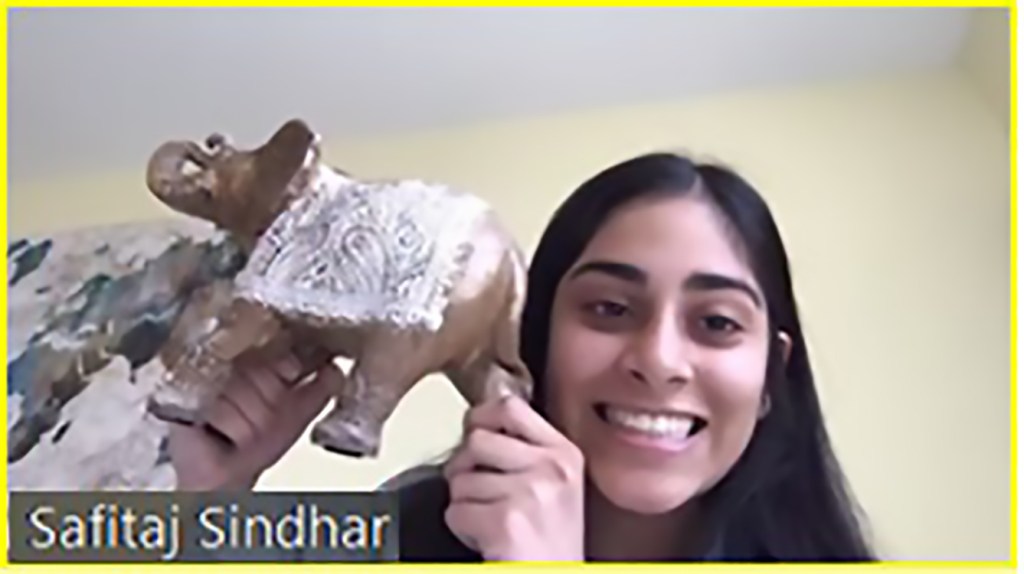
Beasts was different—from start to finish. We delved into concepts other classes merely glanced at. Aristotle’s Historia Animalia was not only discussed but dissected, much as he had done to the animals to understand their structure and function. During one class, Charles Darwin was portrayed in a different light—not as a prodigious naturalist, but as a dejected father—by his own great-granddaughter. Historical events and futuristic inventions were scrutinized and put on trial. Besides, there was not one right way of doing something in this course, and the flexibility allowed us to walk novel paths to the very end when our instructors asked for our ideal final exam. Five months earlier, I would have recommended a Scantron test. Instead, “Zoom View!” was our answer—a virtual show and tell. On the last day of class, twelve voices rose from Zoom’s little boxes, one after another. We showed beasts from our surroundings—sheep and horses, dogs and cats, and my golden elephant—and told of hierarchies, selective breeding, and new ways to bring together our everyday lives with the course material and, from each other, learned even more.
All Together Now
And when you’re alone, there’s a very good chance
you’ll meet things that scare you right out of your pants.
There are some, down the road between hither and yon,
that can scare you so much you won’t want to go on….
You’ll get mixed up, of course, as you already know. You’ll get mixed up with many strange birds as you go.
Oh, the Places You’ll Go, Dr. Seuss
Chaucer’s Parliament of Fowls is filled with “strange birds” that students meet during our course. These birds talk. They argue. They are arranged by hierarchical order. But before Chaucer, or his persona, can get “mixed up” with them, he comes face to face with a gate, which is engraved on one side with an invitation to that “blissful place…the way to all good adventure” and, on the other, with a warning, “of the sphere of which Disdain and Danger are the guides, where no trees shall bear fruit or leaves.” He does not choose to “go on”—“To enter or leave”; rather, his guide pushes him through.
My guides say:
In one respect, I’m grateful the transition to remote learning during the COVID year arrived as a tsunami rather than a gentle wave of change. If there had been any hope of avoiding the switch to online education, or some conceivable way to ride that wave gracefully, I might have frozen, stymied by the desire to chart the optimal course while the second half of the semester overwhelmed me. Instead, I took a breath and plunged forward—accompanied, supported, and (yes) led by my colleague and, increasingly, my students. They showed me how to break loose of what I’d done before, what I’d already planned, what I felt was expected, and they showed me how to trust students to perform and speak and achieve beyond what we or they can imagine. And then, as we faculty prepared for the following semesters, when we were offered a bewildering array of options for what our classrooms might look like, I was almost paralyzed by the possibilities—but not quite. The pandemic radically altered the means by which we relate to one another, but helped me more fully realize the importance of those relationships. Together, we stayed afloat. (B.W.)
Spring 2020 was full of unexpected twists and turns. Within a few short days, I went from sitting in a classroom with a paper and pen in hand to sitting in front of my laptop’s split screen with Zoom on one side and Google Docs on the other. Being only a second-semester student at the time, I was still in the process of finding the right place for me in college, and with the campus closing, it felt as though I was back at square one. The “college experience” depends on proximity and the relationships that develop because of that proximity. That connection is difficult to form when the way to communicate with your peers (and potential friends), who are tens or hundreds or even thousands of miles away, is via a computer screen. However, it is not impossible. During these trying times, Beasts and its students came together, for as it turns out, people bond over shared struggles and challenges. By the time spring semester ended, I realized we, as a class, had accomplished even more than we had expected, given the extraordinary circumstances. In Origin of the Species, Darwin emphasized the survival of the fittest—of those that are most adaptable to the changes in their environment. And by adapting together, we, the Beasts, ensured not only survival, but also success. (S.S.)
And Another Thing
Adaptation continues, in the near time, this semester. Bryan and I have adapted what we learned from Safi’s class, and adapted to what we have experienced since then. This cohort is different: warier, if possible; more anxious it seems; yet altogether familiar: eager to see how we are going to make medieval bestiaries relate to molecular biology. That, by the way, is the easy part. We’ve worked and written on making connections for many years now. The challenge is how to engage students in new ways of learning, methods they can learn from and, also, that may be useful in their future. Our present students were in middle school or high school during COVID, the impact of which is just now being mined for its effects on learning, socialization through the classroom in contrast to Zoom, attitudes to education, and impacts.
We invited Safi, and two other former students, to attend this semester’s iteration of the course they had taken, five years ago for Safi, three years ago for the other two, with the hope that they might be able to speak to the concerns and fears of our present students and answer any questions they had—with the teachers out of the room. We had done the same thing when Safi was a student: three students from the maiden class before hers had come to her class. Of course, those that came to Safi’s class could not allay fears about disruptions beyond the teachers’ control, nor did the students five years later have any questions about her COVID-era class. What was urgent to them, as it had been to her, was the unfamiliar, even odd, combination of teachers and their disciplines, the way pedagogies seemed to vary radically, which meant that they didn’t know what to expect, that they couldn’t fall back on old formulas for getting A’s or just passing. How would they, or could they, respond to what seemed to lack a familiar order of things, a rubric detailing what each point was worth, a script of lectures and orchestrated discussion. They were faced with disruption of the kind Safi describes above, the disruption before the COVID disruption. They were expected to learn through—and because of—this disruption. They would be called upon, as the poet and teacher Theodore Roethke put it, to a different purpose, “to learn by going.”
Thus, although it was difficult to see this in 2020, adaptation is not a one-and-done response to an extraordinary set of circumstances; it is what this essay and this collaboration is about: not the past, but the present and the future of education. The “leading out” of ex ducere (“e” and “duc”) is not Platonic: we are not called to lead students from darkness to light. Rather, the leading, especially now, needs to be in adapting, guiding students to shift from what’s so familiar they forget to think much about it—how they’re taught, what they’re taught—so that they might create something meaningful for themselves, and make the future worth living for themselves and, ideally, for others.
 New Chaucer Studies: Pedagogy and Profession, newsletter
Leave a comment